
Constellations Visible Tonight
Sky Map
Celestial bearing and elevation at 02:28
Browse the constellations currently visible, their brightest stars and positions in the sky.
Andromeda
Constellation
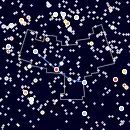
Andromeda, named after the mythical princess, is a constellation in the northern sky known for containing the Andromeda Galaxy, the nearest large galaxy to the Milky Way.
Aries
Constellation
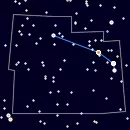
Aries, the ram, is a zodiac constellation located in the northern celestial hemisphere, associated with the story of the Golden Fleece in Greek mythology.
Auriga
Constellation
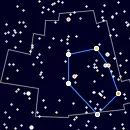
Auriga, the charioteer, is a constellation in the northern sky with the bright star Capella, one of the brightest stars visible from Earth.
Camelopardalis
Constellation
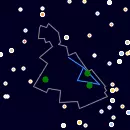
Camelopardalis, the giraffe, is a large but faint constellation in the northern sky, representing a giraffe or a camel.
Cancer
Constellation
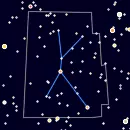
Cancer, the crab, is a small constellation in the zodiac, known for its dim stars and the open cluster Praesepe, or the Beehive Cluster.
Canis Minor
Constellation
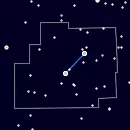
Canis Minor, the lesser dog, is a small constellation in the northern sky, containing the bright star Procyon, part of the Winter Triangle asterism.
Cassiopeia
Constellation
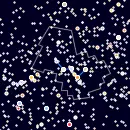
Cassiopeia, representing a mythical queen, is a W-shaped constellation prominent in the northern sky and easy to recognize due to its unique shape.
Cepheus
Constellation
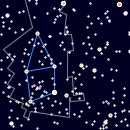
Cepheus, the king, is a northern constellation named after the mythological king Cepheus of Ethiopia. It contains the star Alderamin, part of the northern sky's circumpolar stars.
Cetus
Constellation
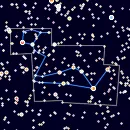
Cetus, the sea monster or whale, is a constellation in the celestial equator associated with the Greek myth of Andromeda and Perseus.
Gemini
Constellation
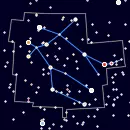
Gemini, the twins, is a zodiac constellation representing the mythological twins Castor and Pollux. It is known for its bright stars, Castor and Pollux, and its prominent place in the winter sky.
Leo Minor
Constellation
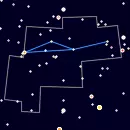
Leo Minor, the smaller lion, is a northern constellation representing a little lion. It contains several faint stars, including Praecipua, and is located between Ursa Major and Leo.
Lepus
Constellation
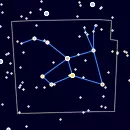
Lepus, the hare, is a small constellation located south of Orion, representing a hare in Greek mythology.
LYNX
Constellation
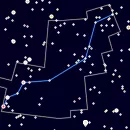
Lynx, the lynx, is a faint northern constellation. Its name refers to the animal known for its sharp sight, symbolizing the challenge of finding its dim stars.
Monoceros
Constellation
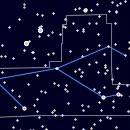
Monoceros, the unicorn, is a faint constellation located near Orion, known for containing several star clusters and nebulae.
Orion
Constellation
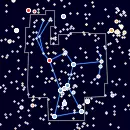
Orion, the hunter, is a famous constellation with distinctive stars, including Betelgeuse and Rigel, and the Orion Nebula.
Perseus
Constellation
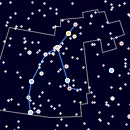
Perseus, named after the Greek hero, is a constellation known for the Perseid meteor shower and the star Algol, also called the Demon Star.
Pisces
Constellation
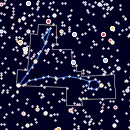
Pisces, the fish, is a zodiac constellation representing two fish tied together by their tails and is associated with the Greek myth of Aphrodite and Eros.
Taurus
Constellation
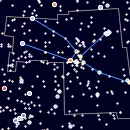
Taurus, the bull, is a zodiac constellation containing the Pleiades and Hyades star clusters and the bright star Aldebaran.
Triangulum
Constellation
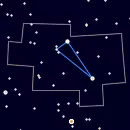
Triangulum, the triangle, is a small constellation in the northern sky known for containing the Triangulum Galaxy (M33), a member of the Local Group.
Ursa Major
Constellation
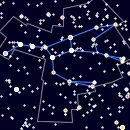
Ursa Major, the great bear, is a prominent constellation best known for containing the Big Dipper asterism, which is used to locate Polaris, the North Star.
Acknowledgements
We gratefully acknowledge the International Astronomical Union (IAU) for defining and standardizing the official constellation boundaries used in celestial mapping.
Special thanks to Sky & Telescope Magazine and contributors Roger Sinnott and Rick Fienberg for producing the charts and tables. Alan MacRobert’s constellation patterns were influenced by the work of H. A. Rey and adjusted to align with earlier traditions.