
Mars Position and Visibility Tonight
Is Mars Visible Tonight?
From your location, Mars is visible from before midnight until sunrise. The current position, altitude, direction, and tonight’s rise and set times are shown below.
When Is the Best Time to See Mars Tonight?
The earliest practical time to observe Mars tonight is around 02:49, when it is already about 38° above the horizon. It reaches its highest point of about 54° around 04:10.
When Is Mars’s Next Opposition?
The next opposition of Mars is on February 20. Around opposition, the planet is opposite the Sun in the sky and is generally at its best for observing.
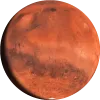
Where is Mars right now?
Twilight begins at 02:29 local time. At that moment, Mars will be 34° above the horizon toward the east.
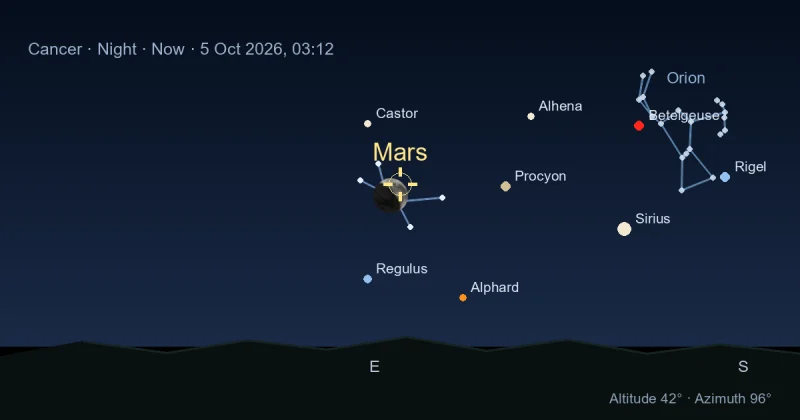
Mars visibility on 2026-10-05
Mars rise and set timetable
| Time | Elevation | |
| Mars transit | 06:40 | 73° |
| Moonset | 13:37 | 1° |
| Mars set | 13:45 | |
| Astronomical observing session begins | 18:12 | -32° |
Moonrise, 34% illuminated 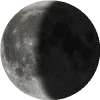 | 22:25 | -11° |
| Mars rise | 23:33 | |
| Astronomical observing session ends | 03:40 | 48° |
| Twilight end (−12°) | 04:10 | 54° |
| Civil sunrise | 04:40 | 60° |
| Sunrise | 05:08 | 64° |
Track Mars position throughout the night
← 5 October 2026 →
| Time | |
| Altitude | |
| Azimuth |
Mars Moon Positions
Mars Map
Mars Features
Utopia Planitia: A large plain within the largest recognized impact basin on Mars, it is notable for its smooth surface and the location of the Viking 2 landing site.
Amazonis Planitia: A vast plain in the northern hemisphere, known for its smooth surface and relatively young geological features.
Hellas Planitia: An enormous impact basin over 2,300 km in diameter and 7 km deep, making it one of the largest known impact craters in the solar system.
Tharsis Montes: A volcanic plateau hosting three large shield volcanoes—Arsia Mons, Pavonis Mons, and Ascraeus Mons—each towering over 14 km high.
Olympus Mons: The tallest volcano in the solar system, Olympus Mons stands about 22 km high and spans 600 km in diameter.
Discover even more Martian features with our interactive, high-resolution Mars map
Upcoming Events
| Time | Description | Constellation |
|---|---|---|
| 11 January 2027 | Retrograde motion of Mars begins | Leo |
| 20 February 2027 | Mars is at opposition | Leo |
| 2 April 2027 | Retrograde motion of Mars ends | Leo |
Current position in the Solar System: Mars
| Date | Mon, 5 October 2026 |
| Distance from Earth | 1.6377 AU (244,996,433km) |
| Elongation | 68° |
| Angular diameter | 5.7" |
| Magnitude | 1.1 |
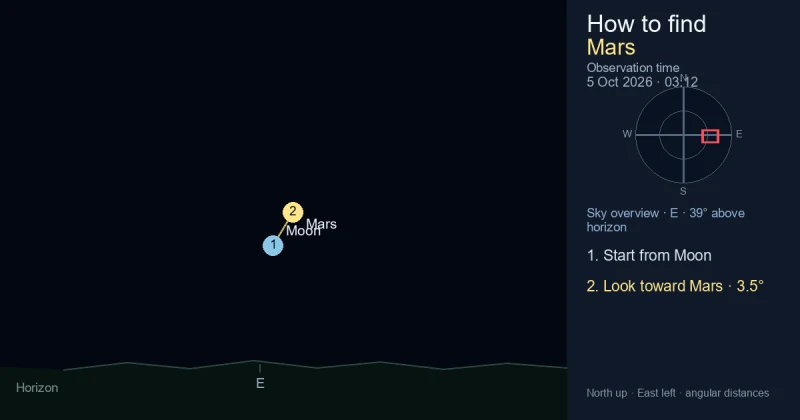
Mars Passage Through Night
Current position of Mars
| Time | 02:29 |
| Latitude | 37.3541 |
| Longitude | -121.955 |
| Elevation | 34° |
| Azimuth | 89° |
When Is Mars Visible Throughout the Year?
| Date | Tue, 6 October 2026 |
| Astronomical observing session begins | 18:06 |
| Astronomical observing session ends | 03:34 |
| Astronomical observing duration | 9h 28m |
| Rise | 23:31 |
| Set | 13:39 |
| Elevation at transit | 73° |
| Transit time | 06:35 |
| Equatorial coordinates | RA: 08h 28m 47s", Dec: 20° 11' 14s |
| Magnitude | 1 |
| Constellation | Cancer |
You can also see when Mars is visible throughout the year in a table with exact rise, transit, and set times for each date.
Astrometric and Physical Parameters of Mars
Coordinates and Visibility
| Right Ascension | 08h 27m 32s |
| Declination | 20° 14′ 60″ |
| Magnitude | 1 |
| Constellation | Cancer |
| Elevation | 33.8° |
| Azimuth | 89.2° |
| Distance to Earth | 1.6343 AU |
| Angular diameter | 5.7″ |
| Elongation from Sun | 68° |
| Illuminated fraction | 90.3% |
Basic Properties
| Mass, kg | 6.4171E+23 |
| Mean density, g/cm³ | 3.933(5+-4) |
Orbit
| Orbital period, days | 686.98 |
Rotation
| Sidereal rotation period, days | 24.622962 hr |
| Mean solar day, days | 88775.24415 s |
Surface and Atmosphere
| Surface gravity, m/s² | 3.71 |
| Escape velocity, km/s | 5.027 |
| Surface pressure, bar | 0.0056 |
| Mean temperature, K | 210 |
Brightness
| Visual magnitude V(1,0) | -1.52 |
Data Acknowledgment
Solar-system physical and orbital parameters are provided by the Solar System OpenData API maintained by Le Système Solaire. We thank its contributors for making these open data available.